Mini Split Installation in Gaithersburg, MD
A new system here will heat from October through April and cool from June through September every year. Tell us about the house, and a licensed contractor who covers Montgomery County will get in touch.
Tell us about the job
It takes about a minute.
Eleven months of work, out of one unit
Gaithersburg gets about one month a year where a mini-split can rest. From October through April it has to hold up on nights that average 27°F. From June through September it has to keep up on afternoons around 85°F. That is real work in both directions, most of the year.
A new mini-split has to clear a federal floor. Split-system heat pumps built from 2023 on must reach 14.3 SEER2 for cooling and 7.5 HSPF2 for heating. Given how many months this one will run, it is worth knowing how far above that floor the unit you choose sits. Montgomery County has also logged 23 winter storms and 443 damaging wind events over the past ten years. A mini-split with a heat pump is one of the few ways to keep a home warm if the furnace or the power goes out.
- 7 months
- October through April, your system heats
- 4 months
- June through September, it cools
- 27°F
- the average winter night it heats against
- 85°F
- the average summer afternoon it cools against
NOAA nClimDiv, 1991–2020 normals
Maryland requires HVAC contractors to hold a state license.
That license is issued to the contractor, through the Maryland Board of Heating, Ventilation, Air Conditioning, and Refrigeration Contractors, and it covers the business, not this particular installation. It does not need to be renewed job by job.
For the mini-split itself, most cities and counties require a permit from the local building office and an inspection once the work is done. That inspection is what gets someone to look at the line set and the electrical connection before the job is considered finished, and it is separate from the state license.
Sources: Maryland General Assembly · Maryland Department of Labor
- Is a mini split worth it?
- For the right house, yes. A mini split heats and cools without ducts, so it works well in a room addition, a converted garage, or a house that never had ductwork to begin with. Winters here run cold enough, down to 27°F on a typical night from December through February, that the heat pump needs to be rated for that kind of cold. A contractor can tell you whether your house is a good fit or whether central ductwork makes more sense.
- How many rooms can a mini split cover?
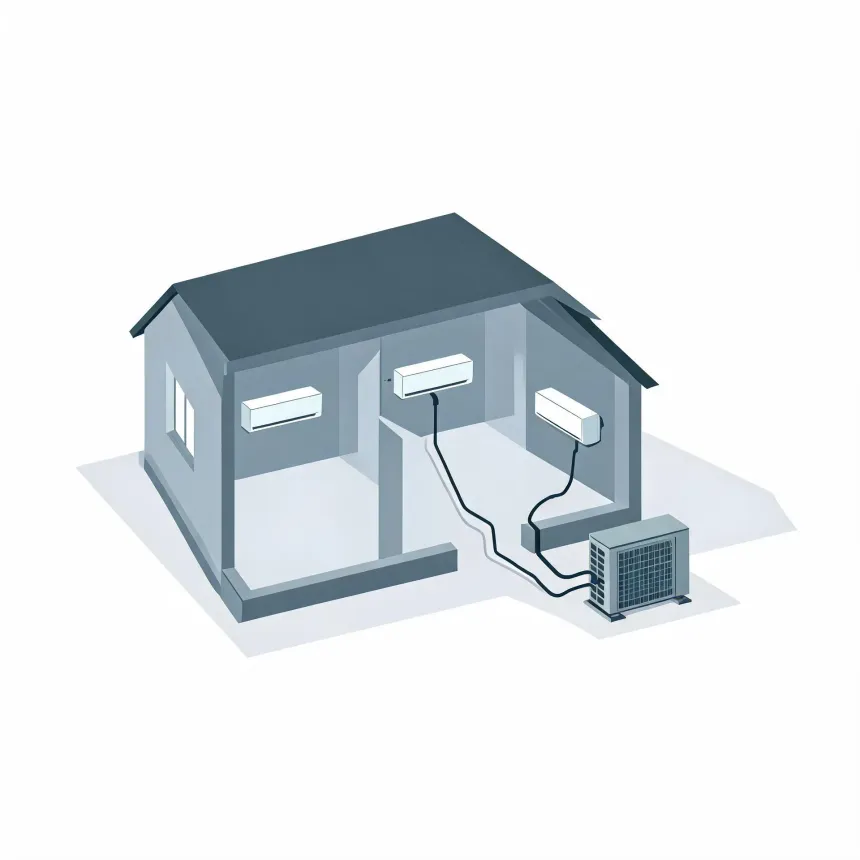
- A single indoor unit is built for one room or one open space. If you need to cover several rooms, a multi-zone system lets one outdoor unit run two or more indoor heads, each with its own thermostat. How many zones a single outdoor unit can run depends on the equipment, so a contractor will size it to the rooms you want covered.
- Can a mini split heat a whole house?
- It can, with enough indoor units to cover every room and an outdoor unit sized for the whole load. Homes here need heat from October through April, seven months a year, so the system has to be sized for that stretch, not just the coldest week. Getting this right means measuring every room, not guessing at the total, so a contractor will need to work out the load for your house before sizing it.