What to do when the AC goes out in Maryland

RepairCentral ACMaryland
Step 1 of 2

What ZIP code is the job in?

First, check the breaker and the thermostat batteries, since those cause more dead air conditioners than anything inside the unit. If power is reaching it and nothing runs, the problem is usually the capacitor, a tripped high-pressure switch, or a condenser fan motor that's seized up. In Maryland, a summer afternoon without cooling gets uncomfortable fast, and the air inside gets humid as well as hot, since the AC is what pulls the moisture out. Most homes here heat with electricity, so the same panel that feeds your furnace or heat pump in winter feeds your AC now, and a breaker that trips repeatedly is telling you something is drawing too much current and needs a look before you reset it again. Shut the system off at the thermostat if it's tripping breakers or making a new noise. Running it in that state risks turning a repair into a replacement.

A gray outdoor air conditioner condenser unit on a concrete pad beside a house with white horizontal siding and a brick foundation, with a wall-mounted disconnect box and conduit, and a green shrub with mulch at left.

Running the way it should

Air moves out of the vents cold and steady, and the condenser cycles on and off without strain. The pad outside stays clear, the grille clean, and the disconnect box sits untouched beside it. In a Maryland summer, this is what keeps the electric bill from climbing further.

An outdoor air conditioning condenser unit on a concrete pad beside a house with white horizontal vinyl siding, with a gray electrical disconnect box and refrigerant lines on the wall behind it.

Signs of a unit in trouble

Dirt and grime cake the grille and top cover, which blocks the airflow the condenser needs to shed heat. A unit working that hard against its own buildup runs longer to cool the same house, and in Maryland's humidity it may not keep up at all.

A gray-haired man in a dark sweater sits on a light gray sofa in a living room, looking toward a sunlit window with trees outside.
A gray-haired man in a dark blue sweater sits on a light gray sofa in a sunlit living room, looking off to the side, with a potted plant, shelving unit, and large glass doors behind him.
A bearded man with graying hair in a dark green sweater sits on a sofa in a living room, looking off to the side, with a sliding glass door and a dim kitchen doorway behind him.
A gray-haired man in a dark knit sweater sits on a light gray sofa in a living room, looking toward a sunlit window, with houseplants, a lamp, and framed art in the background.

Most outdoor units have two motors, the fan and the compressor, so the fan can keep spinning while the compressor inside has already quit. Getting the compressor started is a small capacitor's job. It delivers the jolt that spins it up, and when it weakens the unit just hums instead of running. Power to that unit passes through a contactor first. The contacts on it pit and stick from years of opening and closing, and eventually it stops passing power at all. Dirt on the outdoor coil makes the compressor push against higher pressure than it should, and that is usually what trips the high-pressure switch and shuts the system down. Refrigerant works the same way. If the charge is low, it is not because the system used it up. It is low because it is leaking out of the coil or a line somewhere. And inside, a condensate line that has clogged will stop the whole system through a float switch, often before any water ever shows up on the floor. A contractor who works on this equipment all summer in Maryland can usually narrow it to one of these before taking the panel off.

Why Central Air Fails

  • A low refrigerant charge almost always means a leak somewhere in the coil or line set, not normal use burning it off.
  • The outdoor fan and the compressor are two separate motors, so one can fail while the other keeps running.
  • A dirty condenser coil makes the compressor work against higher head pressure, which is what trips the high-pressure switch.
  • The contactor is the relay that sends power to the outdoor unit, and its contacts pit and stick after years of cycling.
  • A clogged condensate line will shut the whole system down through a float switch long before any water shows up inside.
  • The start capacitor gives the compressor the jolt it needs to spin up, and a weak one leaves it humming without starting.
A gray outdoor air conditioner condenser unit on a concrete pad beside a house with horizontal siding and a stucco foundation, with a disconnect box and conduit on the wall, decorative gravel, mulch, and a shrub nearby.
Clear air flow and a clean coil let the unit shed heat the way it was built to, so it keeps up when the air outside is heavy and wet.
An outdoor air conditioning condenser unit on a concrete pad beside a house with horizontal lap siding, with an electrical disconnect box and conduit on the wall, mulch and a green shrub to the right, and a concrete walkway in the foreground.
Dirt packed into the coil grilles blocks airflow, and that unit works harder for less cold air while your electric bill climbs.
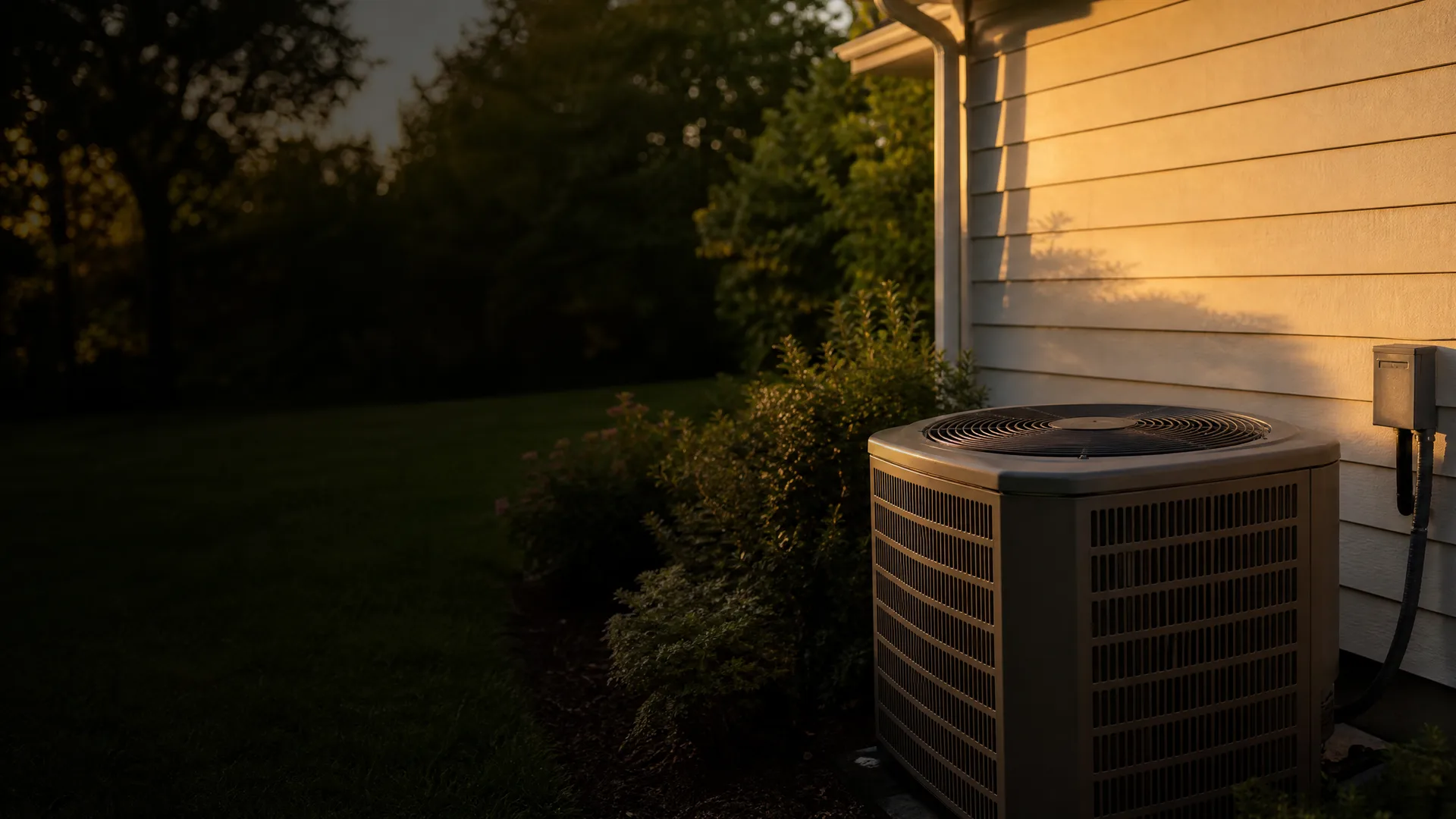
An outdoor air conditioner condenser unit beside a light-colored lap-sided house with an electrical disconnect box on the wall, surrounded by shrubs and lawn in low evening light.

You're out back around seven, watering the tomatoes because it's finally cooled enough to bother. It hasn't, not really. The condenser sits against the fence where it always has, and you notice the quiet before anything else, no hum, no fan turning behind the grille. The light's gone gold and long across the yard. Inside, you already know what you'll find: air coming out of the vents that isn't cold anymore. You crouch down and check the unit anyway, like looking will tell you something. It won't. What it needs is someone who knows this equipment and can get out to you, someone local, not a dispatcher reading off a list.


Get your air conditioner to the right pro

A Maryland summer doesn't pause for a bad capacitor. Once the air inside climbs past what the fans can push around, the house holds that heat through the night, and electric rates here make running window units or fans around the clock an expensive way to wait. Whatever's wrong with your unit, a contractor who works on central air in this area all summer has likely already seen it, in the same style of system, failing the same way. That matters more than finding just any repair company, because the one who knows what tends to go on units like yours can usually get to the actual problem faster than someone guessing from scratch. Your request goes to one licensed contractor local to Maryland, not a batch of strangers bidding for the job. You get a call back from someone who already has an idea what's likely wrong before they see it, which is worth something when the house is holding ninety degrees and climbing.

A grille packed with grass clippings or a coil caked in dust forces the system to run longer to move the same amount of heat, and in Maryland's humidity that extra runtime shows up fast on an electric bill.

A system that runs longer doesn't just cost more. It wears the same parts faster, so the compressor and fan motor that would have lasted are the ones burning out ahead of schedule.

Power costs 19.53 cents per kilowatt-hour statewide

At 19.53 cents per kilowatt-hour, every extra hour your air conditioner runs trying to cool around a dirty coil or a weak capacitor lands on your bill. A unit that's fixed quickly costs you less than one that limps along all summer.

EIA-861 2025 statewide residential average

When Your AC Quits in Maryland

  • Check the breaker and thermostat batteries first; those cause more dead air conditioners than any part inside the unit.
  • If power reaches the unit and it still won't run, the capacitor, a tripped switch, or a condenser problem is the likely cause.
  • A dirty coil or blocked airflow makes the system run longer for the same amount of cooling, and that shows up on your bill fast.
  • The outdoor fan and the compressor are separate motors, so one can quit while the other keeps running.
  • A low refrigerant charge points to a leak in the coil or line set, not normal wear from use.
  • A unit repaired quickly costs less than one left running poorly through a Maryland summer.

Start simple. A dead air conditioner is more often a tripped breaker or dead thermostat batteries than anything mechanical, and that's worth ruling out before anything else. If the unit has power but won't start, look at the capacitor, a tripped high-pressure switch, or the condenser itself. These are specific parts with specific failures, and a contractor who works on this equipment all summer knows which one tends to go first and why.

Even a unit that runs isn't necessarily running right. A coil caked with dirt or a grille blocked with grass clippings forces the system to work longer for the same cooling, and in Maryland's humidity that extra runtime turns into a bill you notice. The outdoor fan and the compressor are two separate motors, so it's possible for one to fail while the other keeps turning, which can make a problem look smaller than it is. A low refrigerant charge is its own warning sign. It almost always means a leak in the coil or line set somewhere, not refrigerant wearing off through normal use, and it won't fix itself.

None of this is a reason to wait and see. A Maryland summer doesn't let up, and electricity here isn't cheap, so a system that limps along costs more than one that gets looked at and fixed. Most of these failures have a specific name and a specific fix, and a local contractor who handles this equipment every season will know which one is in play.

A middle-aged woman with shoulder-length dark hair, wearing a gray cardigan over a cream top, sits in an upholstered armchair and looks toward a sunlit window, with a shelf holding framed pictures and a plant behind her.
A woman and a child wrapped together in a thick knitted blanket on a sofa, both with eyes closed, with a lit table lamp and houseplant in the dim background.

The right pro for this job

A dead air conditioner in a Maryland summer is not something to let sit while you wait and see. The longer a bad capacitor or a dirty coil keeps a unit running hard, the more it shows up on your electric bill. Getting matched puts you in touch with one licensed contractor local to you, someone who works on these systems all season and knows what tends to fail first. No other companies calling, just the one who can get to your unit.

Match me with a pro

The pro who reaches out is licensed in Maryland.

It costs nothing to send, and you don't have to hire anyone.