Mini Split Installation in Cumberland, MD
A new system here will heat from October through May and cool from June through August every year. Tell us about the house, and a licensed contractor who covers Allegany County will get in touch.
Tell us about the job
It takes about a minute.
Cumberland asks a lot of a mini-split
A mini-split here runs 11 months out of the year, heat from October through May and cooling in June through August. That is most of the calendar, not a summer add-on.
Winter nights average 24°F, cold enough that a heat pump has to work for its keep, and summer afternoons average 84°F on the other end. A new unit has to hold up both ways. Any mini-split manufactured now has to meet 14.3 SEER2 for cooling and 7.5 HSPF2 for heating, the federal minimum for split-system heat pumps, so that baseline is set before installation even starts.
- 8 months
- October through May, your system heats
- 3 months
- June through August, it cools
- 24°F
- the average winter night it heats against
- 84°F
- the average summer afternoon it cools against
NOAA nClimDiv, 1991–2020 normals
Maryland requires HVAC contractors to hold a state license.
The license is held by the contractor, not issued per job, so what's on file with the Maryland Board of Heating, Ventilation, Air Conditioning, and Refrigeration Contractors is the company itself, checked once, not this particular installation.
For the mini-split going in, that license is what backs the person doing the work. Beyond that, most cities and counties in Maryland require a permit from the local building office for this kind of installation, with an inspection once it's done, which is what confirms the work was completed properly.
Sources: Maryland General Assembly · Maryland Department of Labor
- Is a mini split worth it?
- For most homes, yes, especially if you're heating or cooling a room that's on its own duct run or has none at all. Homes here need heat eight months a year and cooling for three more, so equipment that holds up through winter nights averaging 24°F and summer afternoons averaging 84°F is doing real work most of the year. A mini split also keeps running room by room during a partial power outage if it's on a circuit a portable generator can carry, which matters somewhere that's seen 106 damaging wind events over the past decade. Whether it's worth it for your house depends on which rooms you're trying to fix and what's heating them now, and that's worth walking through with a contractor.
- How many rooms can a mini split cover?
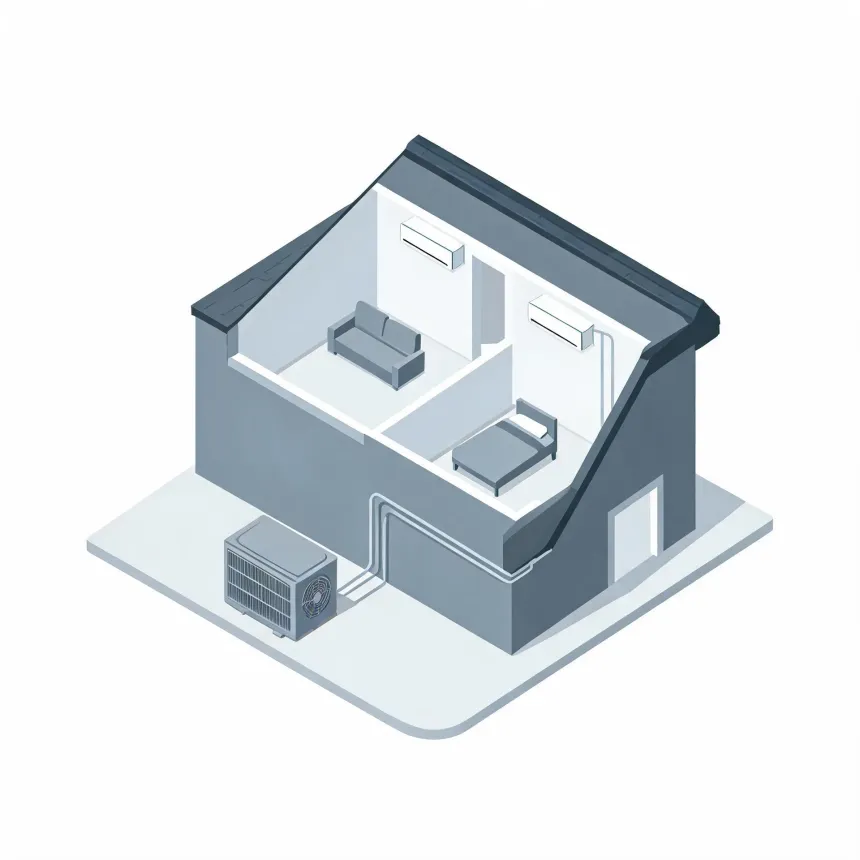
- A single outdoor unit can run one indoor head or several, depending on the system. Single-zone systems cover one room or open area. Multi-zone systems run several indoor heads off one outdoor unit, each with its own thermostat, so you can heat or cool different rooms to different temperatures at the same time. How many zones make sense for your house comes down to the layout and where the heat loss is worst, which is something a contractor sizes room by room rather than guessing at.
- Can a mini split heat a whole house?
- It can, if it's sized and placed for that, but it takes more than one head in most houses. A single indoor unit heats the room it's in and whatever space is open to it. Getting even heat through a whole house means either a multi-zone system with a head in each main area or a ducted mini-split air handler that distributes air the way a furnace does. Winter nights here average 24°F, so whichever setup you choose needs to be sized for that low, not just for a mild day. A contractor can work out how many heads or how much duct that takes for your house.