Signs your ducts need cleaning in Gaithersburg, MD

Skip searching for someone who cleans ducts in Montgomery County.

Start one form

Dust coming out of your vents when the furnace or AC kicks on is the clearest sign. You might see it settle on furniture near a register within a day or two of cleaning. A musty smell when the air handler first starts up points to dust or mold sitting in the ducts themselves, not just the air in the room. Gaithersburg summers get humid, and that moisture can settle in the ductwork and feed mold growth if it's not moving through and drying out. Allergies or coughing that ease up when you leave the house are another signal, since the same air keeps circulating through the same dust. Rooms that seem to collect more dust than others, even right after you clean, often mean the ducts feeding them are carrying it back in. If your vents are visibly dusty around the edges, the inside of that duct run usually looks worse. None of this means the system is broken. It means the ducts are due for a cleaning.

A smiling woman in a cream knit sweater sits at a marble counter with a glass of red wine, with a dining table, pendant lights, and French doors in the dim background.
A smiling woman with long dark hair in a cream sweater sits in a dimly lit open-plan home interior, with a glass of red wine in the foreground and a dining table, fireplace and shelving behind her.
A woman with long dark hair in a black turtleneck laughs while seated at a light stone counter with a glass of red wine, in a dimly lit interior with a potted plant, framed pictures and a hanging lamp behind her.
A woman in a dark sweater laughs while seated at a white marble counter with a glass of red wine, in a dimly lit open-plan interior with a pendant lamp and dining table behind her.

Why does the dust keep coming back

You dust a shelf and two days later it's back, right under the register. That's not bad luck. Air moving through the ducts is carrying it there. Some houses also show it on the AC coil, a gray film that builds up fast when the system runs through a muggy Montgomery County summer and makes the unit work harder to do the same job. Check the supply vents in rooms you don't use much, a bedroom closet or a basement corner. Heavier buildup there than in the rooms you live in every day means the dust is moving through the system, not just settling where people are. Anyone in the house with allergies or asthma usually notices this before anyone else does, coughing or a stuffy nose that eases up when they leave the house for a few hours.

  1. Dust and debris collect inside the duct runs over months of use

  2. Air moving through the system stirs loose dust back into circulation

  3. Registers blow that dust into rooms every time the furnace or AC runs

  4. A technician opens access points and runs a brush through each run

Clean Your Ducts or Look Elsewhere

Worth cleaning now

  • Dust is visible at more than one register, not just the one near the return.
  • A musty smell starts up with the furnace or AC and fades once the system has run a while.
  • You can see debris or dust clumps right at the register when you remove the cover.
  • Someone in the house has started sneezing or coughing more right after the system kicks on.
  • A gray film builds up on the AC coil faster than it used to between filter changes.
  • Rooms farthest from the furnace seem dustier than rooms close to it.

Not a cleaning issue

  • Some dust at the register right after changing the filter is normal and settles on its own.
  • Uneven temperatures between rooms usually points to the ductwork or insulation, not dust inside it.
  • A musty smell that's strongest in the basement near the unit may be a drain line or humidity problem instead.
  • Higher utility bills by themselves don't tell you the ducts are dirty.
  • A whistling or rattling sound from the vents is airflow or a loose panel, not debris buildup.
  • If the smell only shows up after the AC runs in a muggy stretch, condensation is the more likely cause.
Galvanized sheet-metal ductwork and pipes running along an unfinished basement ceiling beside a plain beige wall, with a gray equipment cabinet below.

What a register filter can tell you

Pull the register cover off a vent that's been bothering you and look at the back side of it. A thin gray coat of dust is normal. A thick layer, or clumps of dust and debris sitting right behind the grille, means the duct feeding that room has more built up inside than air movement alone would put there. That's a duct worth looking at, not just a vent worth wiping down.

Galvanized sheet metal rectangular and round HVAC ducts running along a ceiling and down a white interior wall, with exposed wood joists and subfloor above.

The coil tells a different story

If the AC coil inside the air handler is pulling a gray film faster than it used to between filter changes, dust is making it past the filter and settling where air moves slowest. That's usually the return side of the duct system carrying more than it should. A tech checking the coil during a cleaning can tell you if the buildup there matches what's sitting in the duct runs themselves.

How old is your ductwork, and how hard does it work?

  • Half the homes here were built by 1980

    Half the homes in Montgomery County were built in 1980 or earlier. If yours is one of them, the ducts may never have been cleaned.

  • Heat runs October through April

    Furnace and ducts run about seven months a year here, October through April. That's a lot of hours pushing air through the same dust.

  • Cooling runs June through September

    Add four more months of AC, June through September. Eleven months of the year, something is moving air through those ducts.

ACS 2020-2024 · NOAA nClimDiv 1991-2020

Empty concrete-walled basement room with bare floor and an exposed wood-joist ceiling carrying galvanized rectangular and round sheet-metal ducts, black pipes, and wiring.

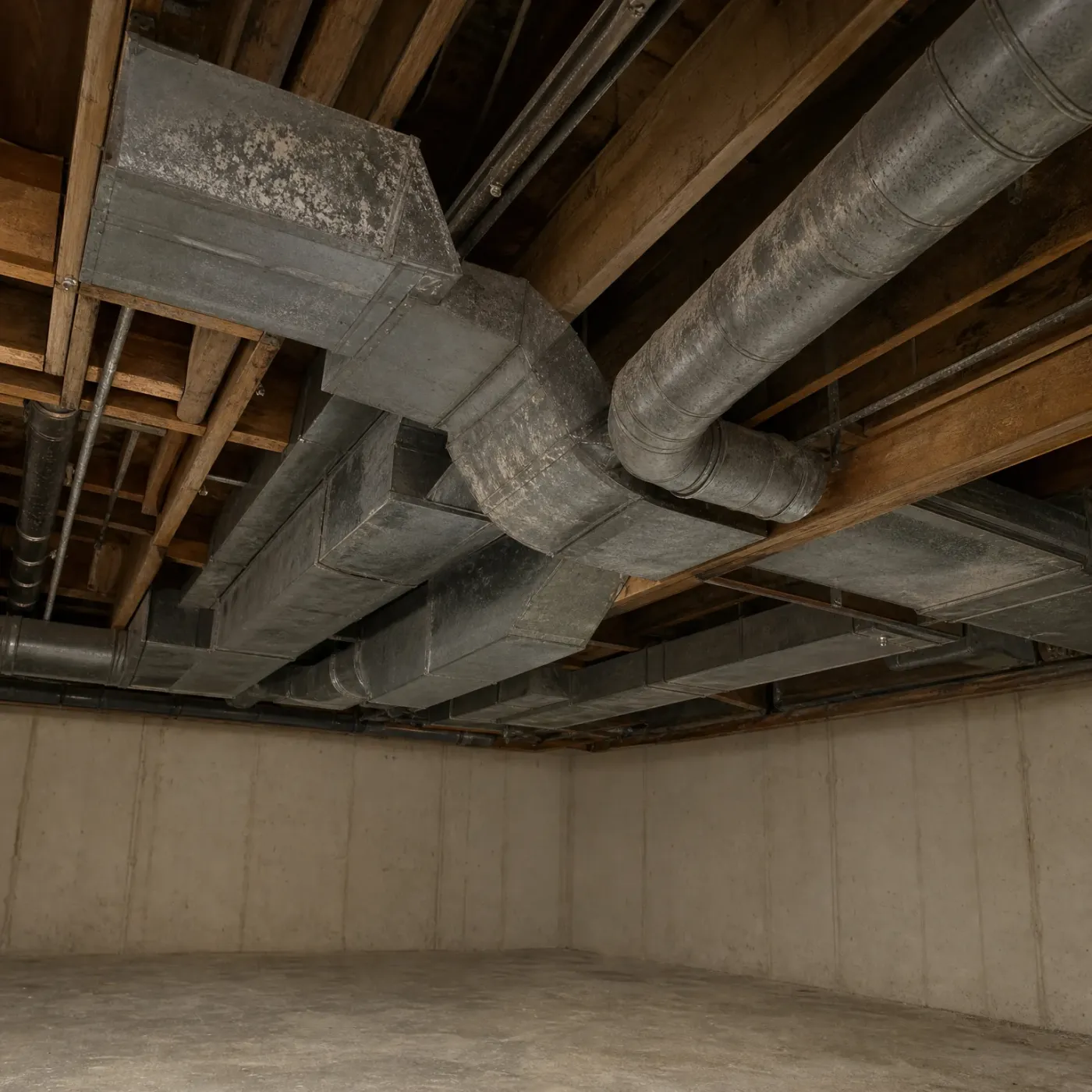
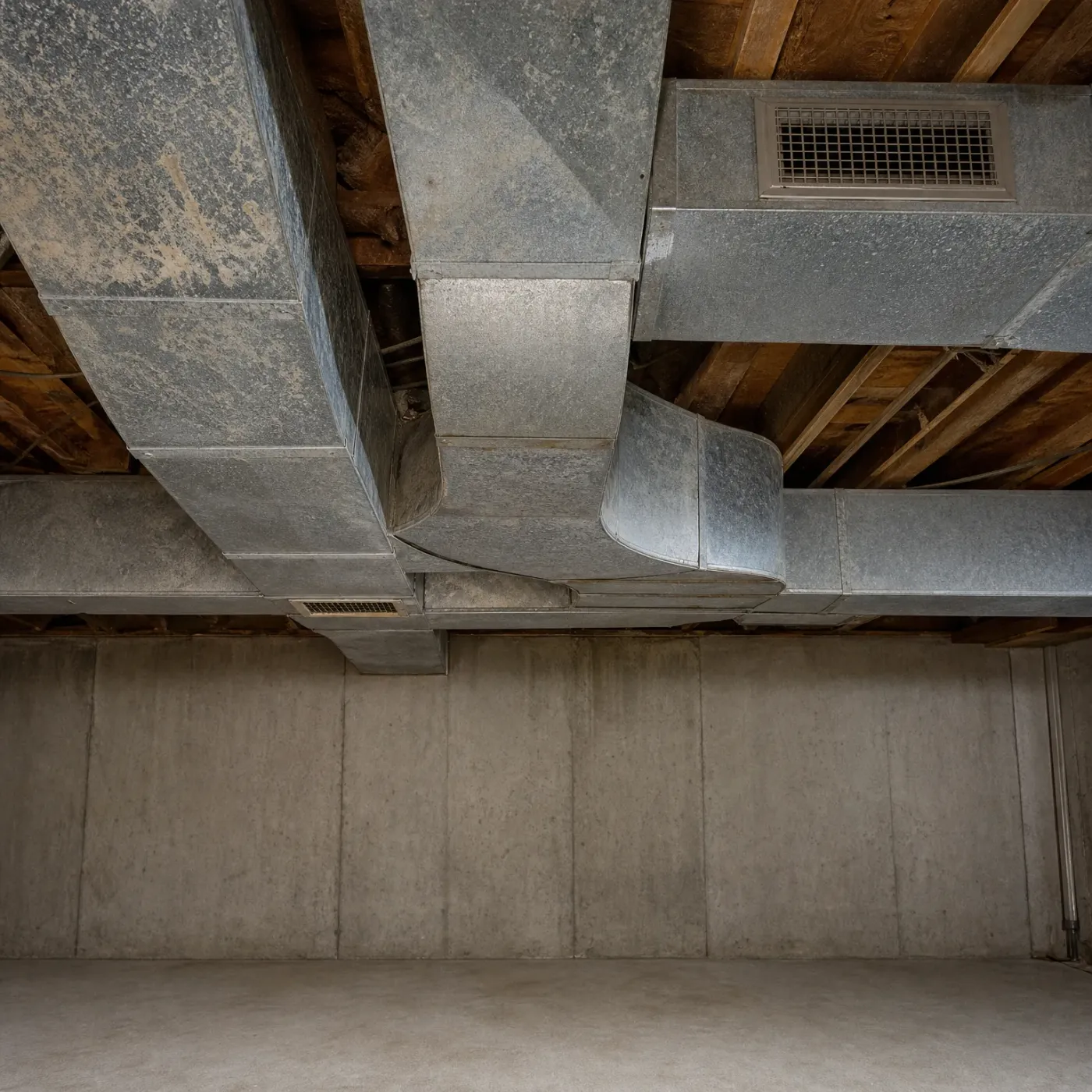
Ducts in good shape

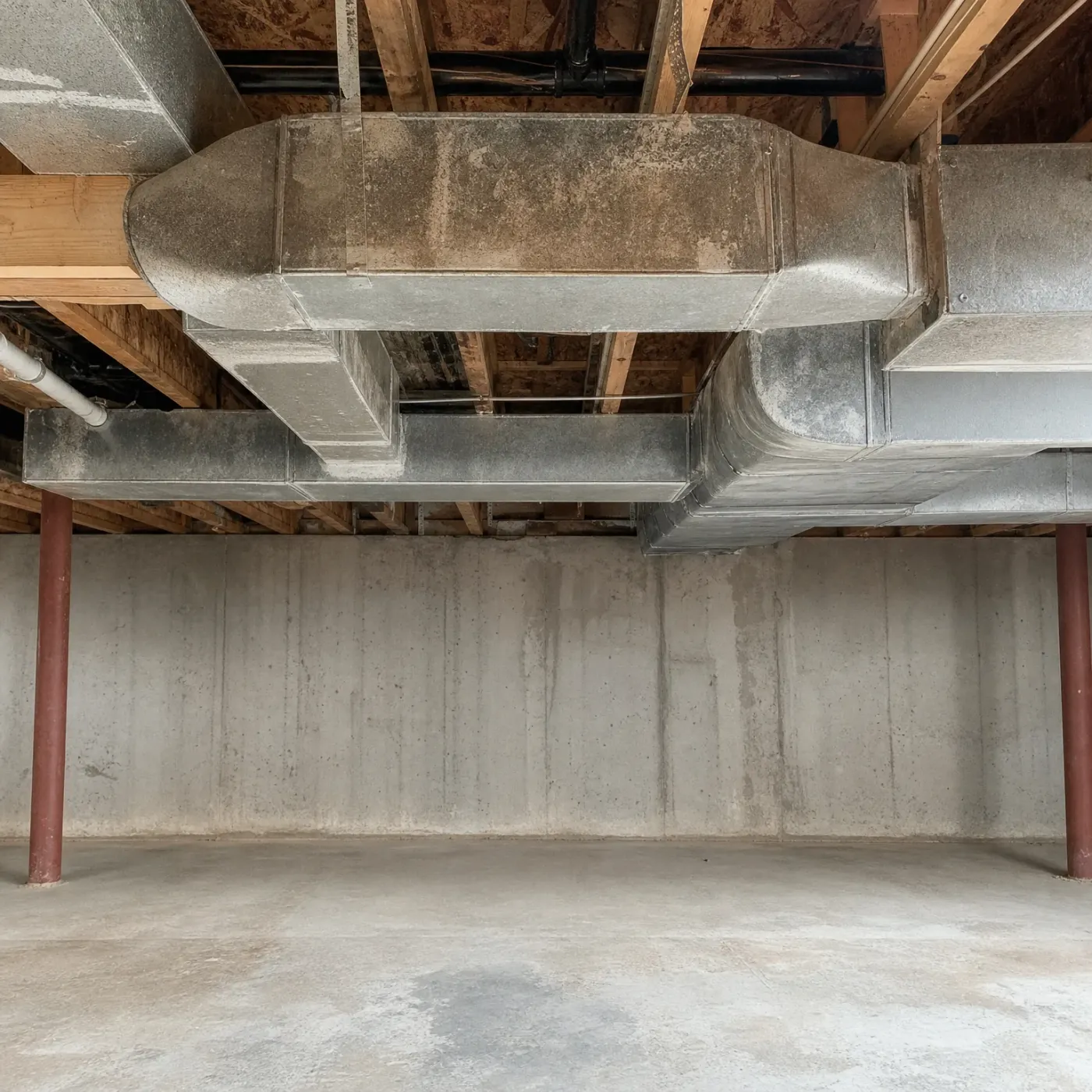
Metal is clean and dry, trunk and branch lines both. No dust rings at the seams, no tape hanging loose. Air moves through without picking up anything it shouldn't, and a register pulled off nearby shows only a thin, even coat of dust on the back.

Empty concrete-walled basement room with exposed wooden joists and galvanized rectangular and round ductwork plus pipes running across the ceiling.

Ducts that need attention

Surfaces have gone dull and gray with oxidation, and dust has built up along every seam and joint. Loose debris sits inside the runs where the furnace or AC stirs it loose every time it kicks on. Pull a register here and you'll find clumps, not a film.

Galvanized sheet metal HVAC ducts with vent grilles run along a wooden floor joist ceiling above bare concrete walls and floor in an unfinished basement.
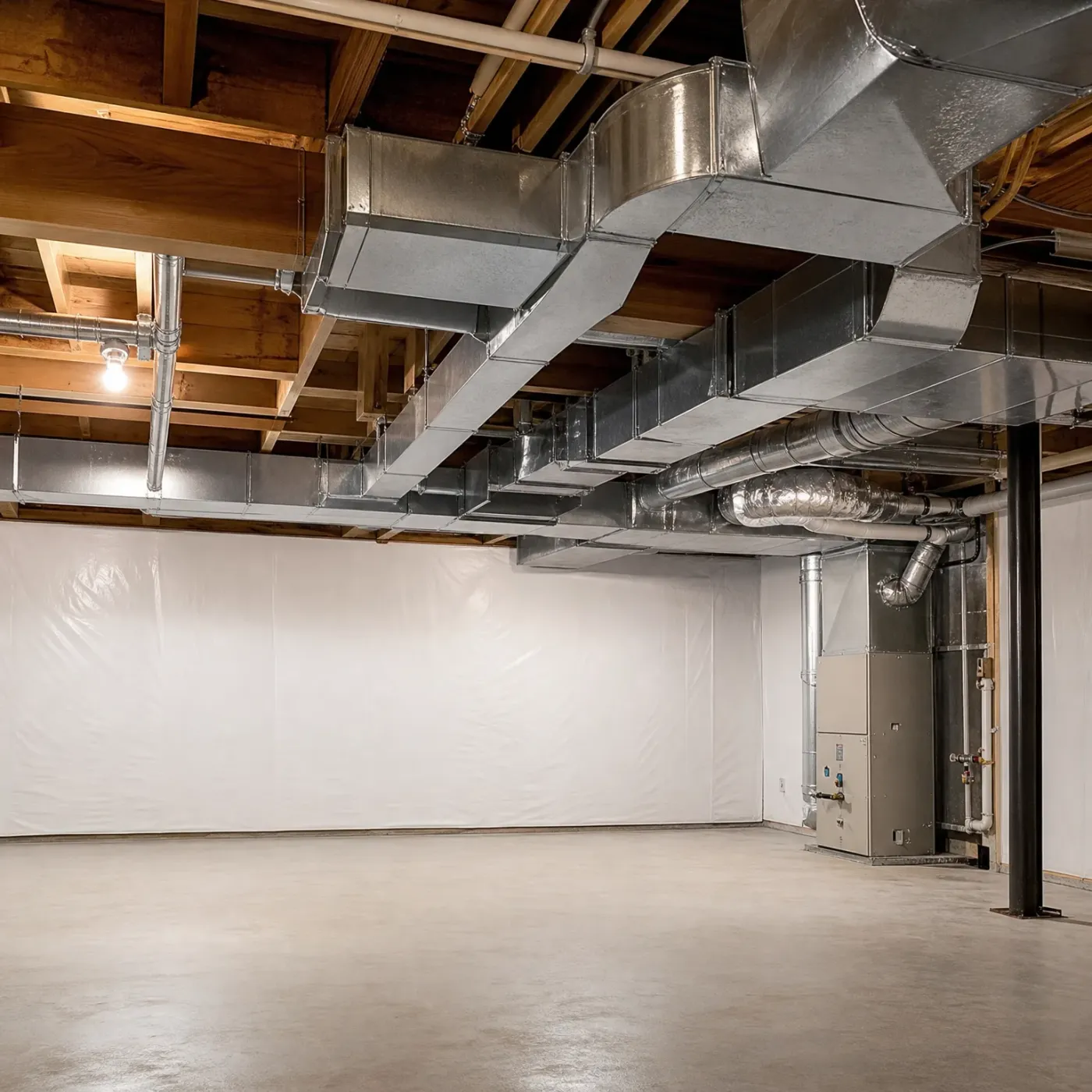
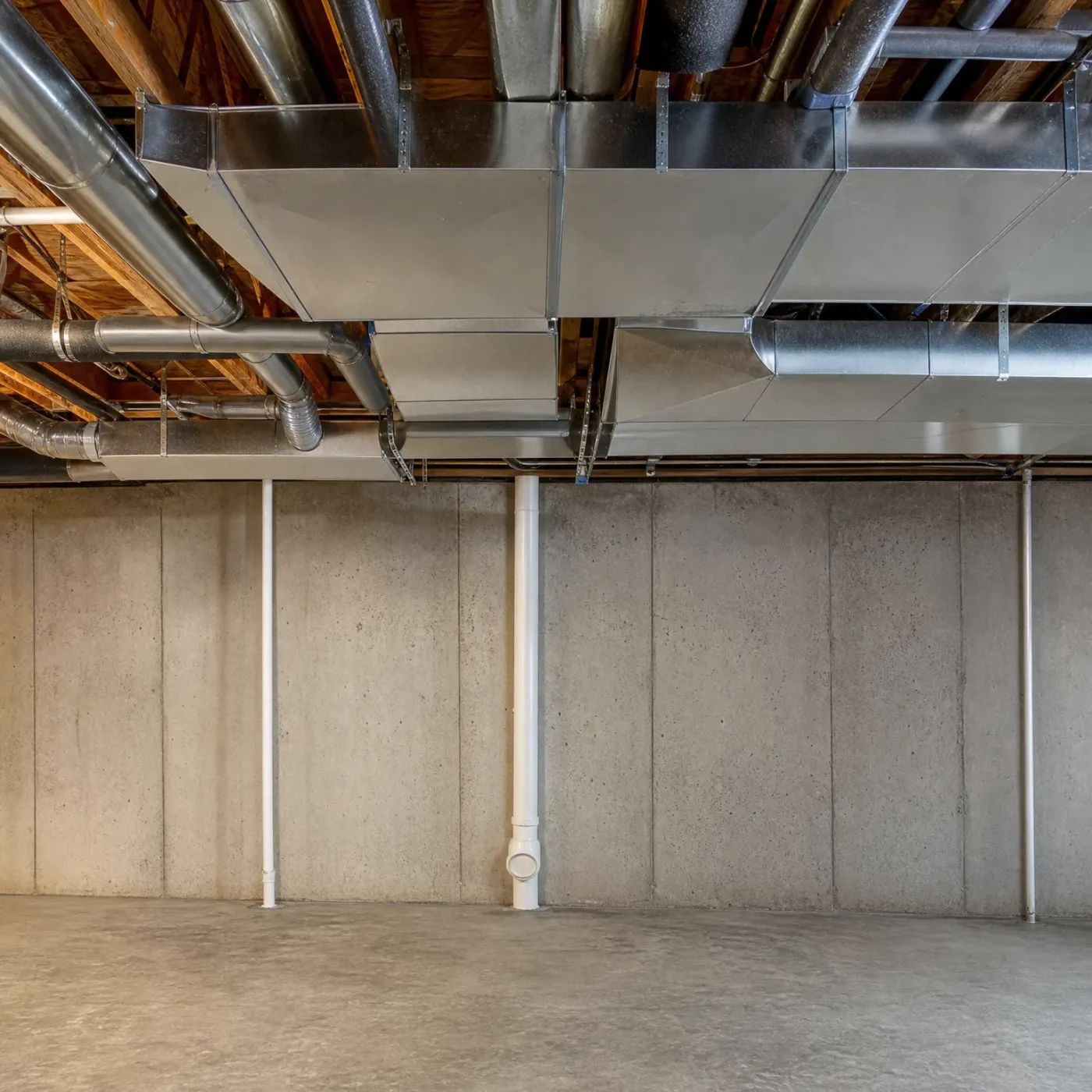
Before you get your ductwork cleaning
Empty basement with bare concrete floor, white plastic sheeting over one wall, exposed wood joists, galvanized sheet-metal ductwork and pipes overhead, and a furnace unit with a steel support column at right.
After you get your ductwork cleaning

No calling every shop in Montgomery County

You've read the signs and you know which ones match what's happening in your house. Maybe it's the dust at more than one register, maybe it's the smell when the furnace kicks on, maybe it's both. What's left is finding someone to open those ducts up and look. That usually means searching around Gaithersburg for duct cleaners, calling a few, describing the same gray film or the same smell three different times, then sitting with quotes that don't explain what they cover. A contractor working this area knows what seven months of furnace and AC runtime does to ductwork in a Montgomery County home, and whether a house from 1980 or earlier is more likely to need it. One request here goes to one local contractor who does this work, not five. You skip the calling around and get to the part where someone actually looks at your ducts.

Unfinished basement with poured concrete walls, a bare concrete floor, white PVC pipes running down the wall, and exposed sheet-metal HVAC ductwork beneath wood floor joists.

Ducts doing their job

This is what a clean run looks like, sealed metal carrying air straight to the register without shedding anything along the way. No dust rings at the seams. No film building up where the pipe bends. Air goes in one end and comes out the other, nothing added.

Unfinished basement with bare concrete walls and floor, galvanized sheet-metal HVAC ducts running beneath wooden floor joists, and two red steel support columns.

Ducts overdue for a look

Same kind of run, same joists overhead, but the metal's been collecting for a while. Seams that loosen or gaps that open let dust settle inside and ride the airflow straight to your rooms. From the basement you'd never know it, until you check the register upstairs.

How does a technician actually clean the ducts?

You've spotted the signs and you're ready to get it done, but it helps to know what actually happens once a technician shows up. Opening up ductwork sounds invasive, and it is, but the process follows a set order every time, whether it's a ranch in Gaithersburg or a split-level out toward Germantown. Knowing the steps tells you what to expect and what to ask about.

The technician seals the system, then vacuums and brushes every run

A technician starts by covering the registers that aren't being worked on and hooking a vacuum to the trunk line, so the whole system is under negative pressure before anything gets disturbed. Then they open access points along the runs and work a brush or air whip through each branch line, knocking dust and debris loose so the vacuum pulls it out instead of letting it settle somewhere else in the house. The furnace blower and coil get cleaned separately, since that's where a lot of the dust collects and recirculates from. Once a run is clear, the access points get sealed back up and the registers go back on.

A smiling man with curly graying hair and a dark knit sweater sits at a candlelit dinner table with a glass of red wine, a water glass and a bowl of salad in the foreground, in a dimly lit room with a lamp, framed picture and window behind him.
A woman in a cream knit sweater reclines on a gray sofa with her eyes closed and a slight smile, covered by a fleece blanket with a closed book on her lap, a lit table lamp and potted plants behind her.

Power here costs 21.03 cents per kilowatt-hour

At 21.03 cents per kilowatt-hour, running the blower longer than it needs to costs you something every month. Dust built up inside the ducts makes the system work harder to push air through, and that extra draw shows up on your bill before you ever see it on a register.

EIA-861 2025

A dimly lit living room corner with a gray wall, framed picture, a table lamp on a wooden side table, a beige sofa with pillows, a ceiling vent, and windows showing flowering trees outside.

It's a Saturday morning in April, warm enough that you've switched the system over to the AC for the first time this year. Sun is coming in through the living room windows. You're on the couch with coffee when the air kicks on, and you notice the ceiling vent grille above the bookshelf has a gray ring of dust around it. The end table underneath has a fine layer across it, the kind you wiped off last weekend. It's already back. You run a finger along the shelf and it comes away gray. The vent keeps blowing, and the dust keeps settling.


A closed laptop and a ceramic mug on a wooden table in front of a kitchen with green cabinets, marble counter, black pot, cutting board, wooden bowl, and a white vase with greenery.

Dust at the register, smell on startup, a film on the coil. That's your answer.

You came here looking for signs, and you've got them now. Dust settling near a vent within a day or two of cleaning, a musty smell when the furnace or AC first kicks on, a gray film on the coil, dust clumped right behind the grille. Any one of those means the ducts are carrying more than air. A few together mean it's worth getting someone out to look.

What's left isn't the hard part, it's just the tedious part: finding a contractor who knows duct systems in older Montgomery County homes, calling around for someone who can actually get out this week, explaining what you've noticed more than once, then sorting through quotes that don't quite compare. A local contractor who works on this equipment all year, through seven months of furnace and AC runtime, already knows what a gray film on the coil means and what it takes to clear a trunk line. You call once and one person shows up to look, not a handful of companies working your number.

A shallow dark wooden bowl and a stack of books rest on a wooden table in front of a beige sofa with linen and green cushions, with a tall ceramic vase of thin branches beside a window in the background.
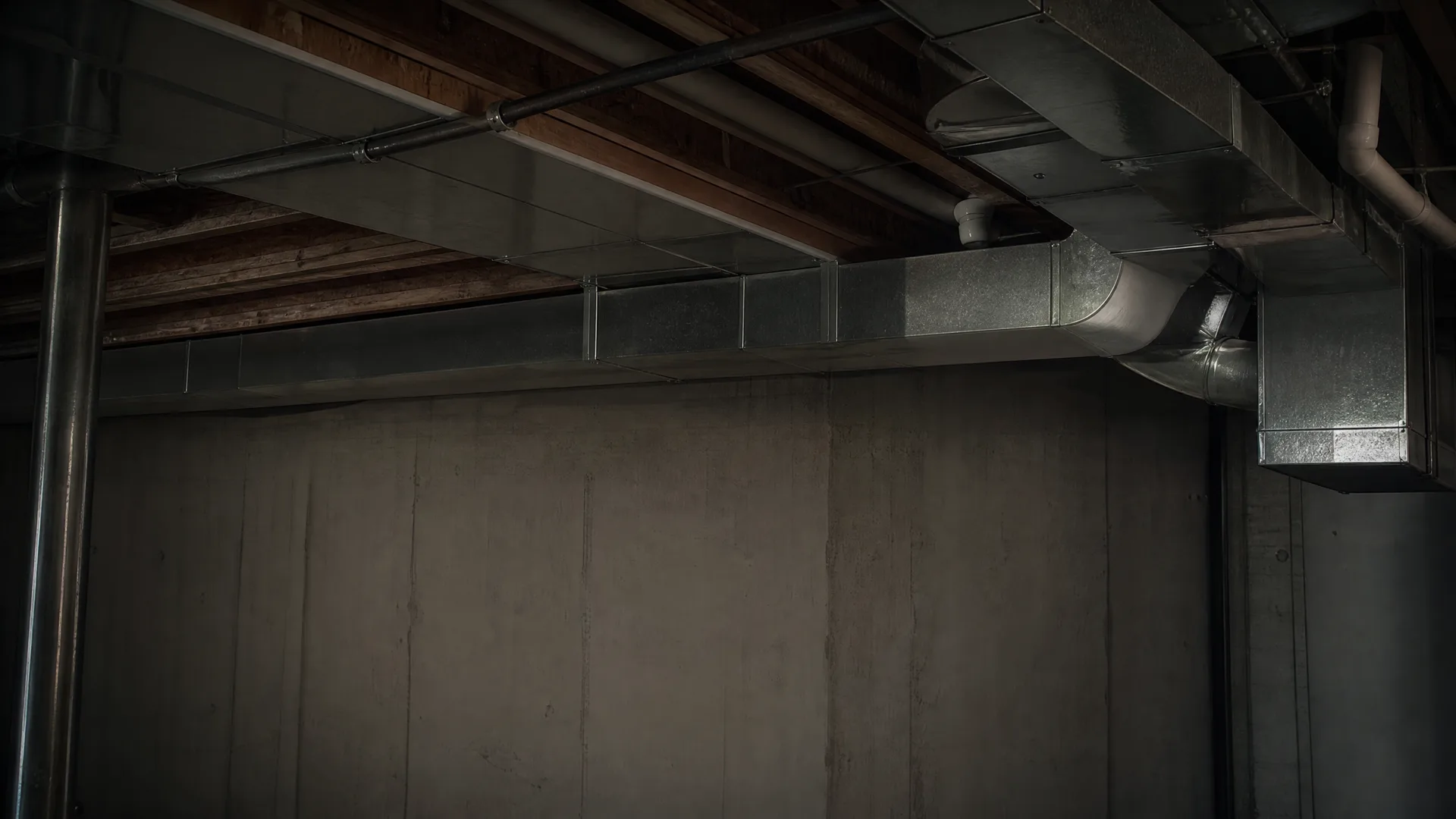
Dimly lit basement interior with galvanized sheet-metal ductwork and round pipes running along wooden floor joists above a bare concrete wall.

Describe it once

A licensed pro who works in Montgomery County gets your request.

Duct and vent cleaningDucts or ventsMontgomery County, MD
Step 1 of 2

What ZIP code is the job in?