Tell a local repair pro what your furnace is doing.
A rattle in your furnace usually means something has come loose or something is spinning when it shouldn't be. Most homes in Maryland heat with electricity, and an electric furnace that rattles is telling you about a blower wheel, a loose panel, or a motor mount, not about a gas valve or a pilot.
The panels on the furnace cabinet are thin metal, and the screws that hold them shut back out over time from the vibration of normal running. That alone causes a surprising amount of rattling, and it is worth checking before anything else.
If the sound is coming from inside the cabinet rather than off the panel, it is more likely the blower wheel or the motor that spins it. A blower wheel with a bent blade or built-up dust will knock against the housing. A motor with worn mounts will shake loose everything around it.
None of this is something to live with through a Maryland winter. Power here is not cheap, and a furnace working harder than it should, pushing air through a wheel that is out of balance or straining against a loose mount, shows up on your bill before it shows up as a bigger repair.
You don't have to figure out which one it is. That's the part a licensed contractor sorts out once they're in front of your furnace, with the panel off and the system running. What you need right now is someone who already knows electric furnaces and knows them in Maryland homes, not a general guess over the phone.
Send in what you're seeing, and a contractor who covers your part of the state will reach out directly. You won't be the one tracking down who's available or explaining the problem twice. Once you submit the form, that search is off your plate.
A rattle almost always comes from one of two places: something loose, or something spinning off balance. Loose panels are the easiest fix, and the most common. The sheet metal access panel on the front of your furnace is held on with a few screws, and if they've backed out, the panel buzzes against the cabinet every time the blower kicks on. Open it, check the screws, and see if that quiets it down. If tightening the panel doesn't do it, the sound is probably coming from inside. A blower wheel that has come loose on its shaft will knock or rattle as it spins, and that gets worse over time, not better. The same goes for a motor mount that has worked loose. These don't fix themselves, and running the furnace with a wheel out of balance puts strain on the motor behind it. If the rattle is new and the panel is already tight, it's worth having someone look at it before the motor is what fails next.
Before you get your furnace repairAfter you get your furnace repair
Furnace noise almost always traces back to something moving that shouldn't be, or something rubbing that used to be loose-free. Timing tells you a lot. A rattle that only happens for the first minute or two, before the burners light, points to the inducer motor, the small motor that clears exhaust out of the heat exchanger ahead of ignition. If a bad bearing is wearing in there, that's the only window you'll hear it. A rattle that gets faster as the blower spins up is different. That's usually a blower wheel that's slipped on its shaft and is now clipping the housing once per turn. Duct work plays a part too. Flex duct held on with a loose clamp will flap against the collar every time air pressure builds behind it, and it only takes a few turns of a screwdriver to find out if that's the cause. A cracked heat exchanger is the one worth taking seriously, since the metal warping against the cabinet as it heats and cools can sound a lot like the others.
What's actually making that noise
A blower wheel that has slipped on its shaft will hit the housing once per rotation, so the rattle speeds up as the blower ramps up.
The inducer motor pulls exhaust through the heat exchanger before the burners light, and a worn bearing in it rattles only during that startup phase.
A cracked heat exchanger can rattle because the metal has warped and now touches the cabinet wall as it expands and contracts with heat.
Loose screws on the blower compartment door let the panel buzz against the frame every time the blower kicks on.
Flex duct connected to the furnace with a loose clamp will flap against the collar each time air pressure builds behind it.
A failing capacitor can let the blower motor run unevenly, and an unbalanced motor shaking in its mount sounds like a rattle.
Get the right pro for your furnace
Send the request today and stop worrying about who to call.
Describe your furnace job, and a local pro who handles it gets in touch.
Why does my furnace rattle more when it first kicks on?
You notice it every time the furnace starts up. A rattle for a few seconds, then it settles down and runs quiet, or close to it, for the rest of the cycle. That pattern is telling you something specific about where the noise is coming from, and it's worth paying attention to before it turns into a bigger repair.
It's loudest at startup because the blower motor is working hardest right then
A blower motor draws the most current and spins up fastest in the first second or two after it kicks on. If a bearing is worn or a blower wheel has worked loose on its shaft, that's the moment it shows up loudest, before the motor settles into a steady speed and the noise either fades or evens out. A loose panel behaves differently. It rattles with the vibration of the blower running, so it tends to keep going the same at the start as it does a minute later. If your furnace gets quieter once it's running, the motor or blower side is the more likely place to look. A contractor can check the wheel and bearing directly.
You're awake before you know why. The house is quiet, that 2 a.m. kind of quiet, and the hallway floor is cold under your feet. No air moving at the vent. You crouch down and hold your hand over it and feel nothing, not even the usual low hum through the floor. Outside the hallway window, frost has worked its way up from the corner of the glass. You've heard the furnace rattle for a week now, something loose, you figured, nothing urgent. It's not rattling now. It's not doing anything. The house is thirty-eight degrees colder outside and the vents have gone silent sometime while you were asleep.
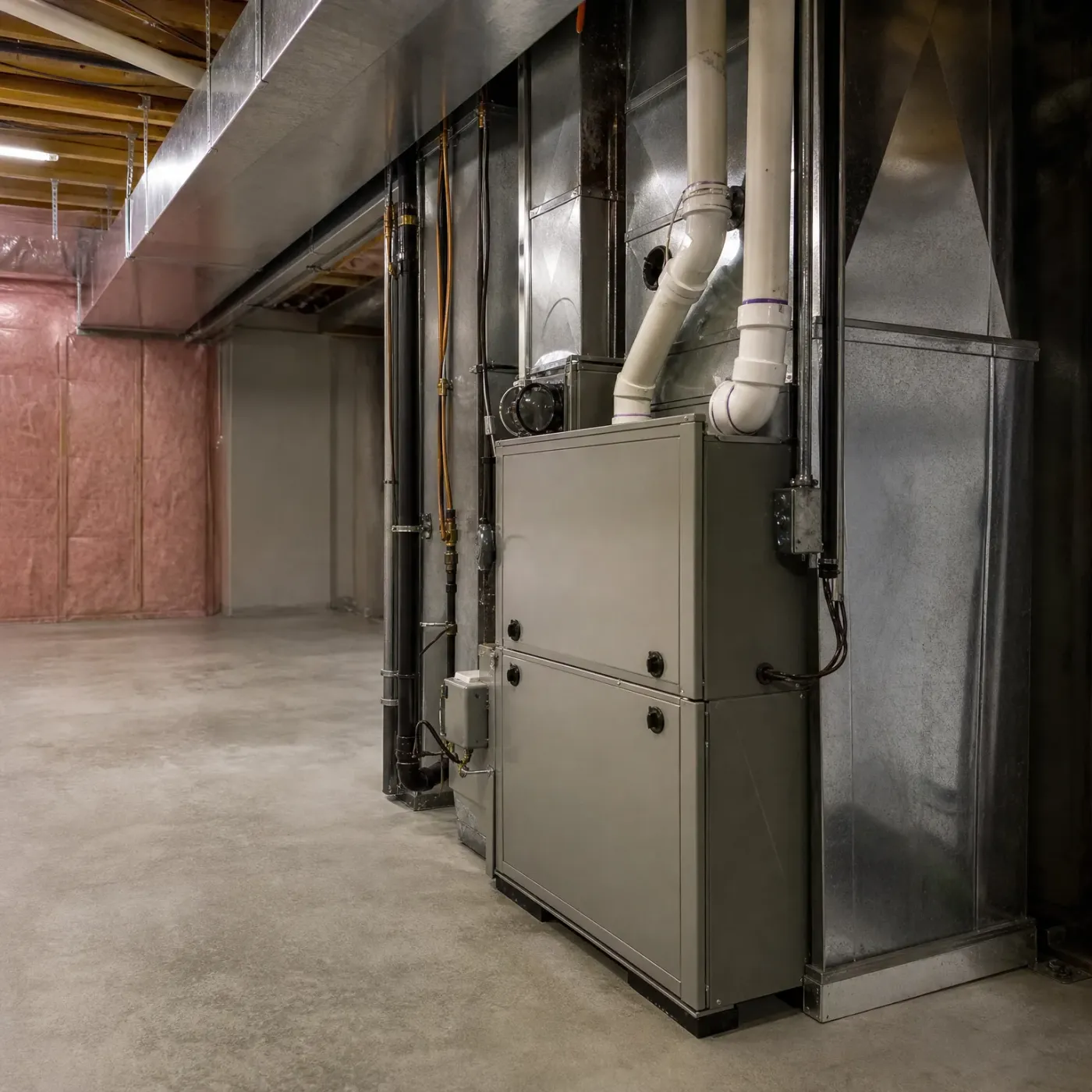
A furnace like this runs quiet because every panel is seated and every part is new, with nothing loose to shake.
A furnace that's run for years of Maryland winters wears at its bearings and mounts, and that's where a rattle starts.
Winter nights average 27°F statewide
On a 27°F night, your furnace isn't cycling on for a few minutes and shutting off. It's running long, steady stretches to hold the house warm, and anything loose or off balance inside it gets more hours a night to shake and wear.
NOAA nClimDiv 1991-2020 county normals weighted by homes
Running the way it should
The panels sit flush against the cabinet, every screw in place. Inside, the blower wheel spins true on its shaft and the inducer motor pulls exhaust through the heat exchanger without a sound. Nothing shakes because nothing has worked loose yet.
Worn down after years of Maryland winters
Dust has built up on the burners and housing, and the gas line and condensate pipes show their age. A mount has loosened somewhere inside, or a bearing has worn, and that's the rattle you're hearing. A contractor can find exactly which one.
A rattle has a reason, and it doesn't fix itself
A loose panel, a blower wheel off its shaft, a worn bearing in the inducer motor. Whatever is making the noise in your furnace, it has a cause you can point to, and it stays there until someone opens the cabinet and finds it. Maryland winters give that part long nights to keep shaking loose or wearing further, cycle after cycle.
Once you send the form, you're not the one who has to track down a furnace tech. A contractor who works on furnaces like yours gets matched to what you've described and reaches out to you directly. The search ends there. What happens with your furnace after that is between you and them.
A pro who works on furnaces
Send the request today and let a furnace pro reach out to you.