




Signs of leaky ductwork in Dundalk, MD

Skip the calls

A musty room that never cools off right, a utility bill that keeps climbing in Dundalk's humid summers, a furnace that runs long into a cold Baltimore County night without the house catching up. These are the kind of things that send people searching for answers about their ducts, and then into the harder search: finding someone who will actually look at them. That usually means a string of phone calls, explaining the same layout and the same symptoms to each one, then waiting on quotes that are hard to compare because no two contractors checked the same things. You can skip that part. Tell us what you're noticing and where you are, and you get matched with one licensed contractor who works on duct systems in this area all year, in the heat and in the cold, and knows what tends to go wrong in homes here. No flood of calls from companies you didn't choose. Just one, ready to take a look.

Leaky ductwork usually shows up as rooms that never feel right. One bedroom runs warmer or colder than the rest of the house no matter where you set the thermostat. The furnace or AC runs longer than it should to get there, and the power bill reflects it. You might feel air moving around the edges of a duct joint in the basement or attic, or notice a musty smell when the system kicks on, which means it's pulling in air from a crawlspace or attic instead of delivering what it conditioned. Dust building up fast near vents is another sign, since leaking ducts pull dusty air from unconditioned spaces into the stream. In Dundalk's humid summers, leaky return ducts can also draw in damp air and make the house feel stickier than the thermostat setting suggests. None of this means the duct system has failed, only that it's losing air it shouldn't.

Why does ductwork in a Dundalk-area home leak in the first place?

  • Half the homes here were built by 1973

    Half the homes in Baltimore County went up in 1973 or earlier, and duct joints and seams loosen with age. If yours is one of them, the ductwork has had decades to work itself loose.

  • Heat runs October through April

    Heat runs about seven months a year here, October through April. That is seven months of conditioned air pushed through the ducts, finding any gap along the way.

  • Cooling runs June through September

    Cooling runs June through September. A duct leak that wastes warm air in winter wastes cool air in summer too, so the loss hits you on both ends of the year.

ACS 2020-2024 · NOAA nClimDiv 1991-2020

Where the air actually goes

  • Air leaking from a duct seam loses its pressure fast, so the room at the far end of that run gets the least air of all.
  • A return duct that leaks pulls hot attic or crawlspace air into the system before it ever reaches the furnace or coil.
  • Flex duct separates at the metal collar where it connects to a boot or plenum, often from a staple or strap that never held.
  • A supply run leaking into a crawlspace pushes warm or cool air outside the house while the blower keeps running to compensate.
  • Duct tape fails within a few years despite the name, and most leaks found later sit at a joint once sealed with it.
  • Rigid metal duct leaks most at the elbows and the transitions, where two pieces were never fully seated before the sheet metal screws went in.

Ductwork doesn't fail all at once. It fails at the connections. Every run of duct is really a chain of pieces, metal or flex, joined at boots, plenums, elbows and collars, and each joint is a place air can get out before it reaches a room. A return leak works against you in a different way than a supply leak. On the return side, the blower pulls air from wherever it can get it, so a gap in a return run sitting in a hot attic means the furnace or coil is working on air that's already heated up before it starts. On the supply side, a leak just lets conditioned air escape into the attic or crawlspace instead of the room it was meant for, so the blower keeps running to try to make up the difference.

Flex duct and rigid metal fail differently too. Flex tends to pull loose at the collar, where a strap or staple was supposed to hold it tight and didn't. Rigid metal holds up along a straight run but opens up at the elbows and transitions, where two pieces of sheet metal were screwed together without ever sitting flush. And if someone patched a joint with duct tape at some point, that's worth checking first. It holds for a few years, then lets go, and a lot of the leaks a contractor finds later turn out to be old tape joints that gave out quietly.

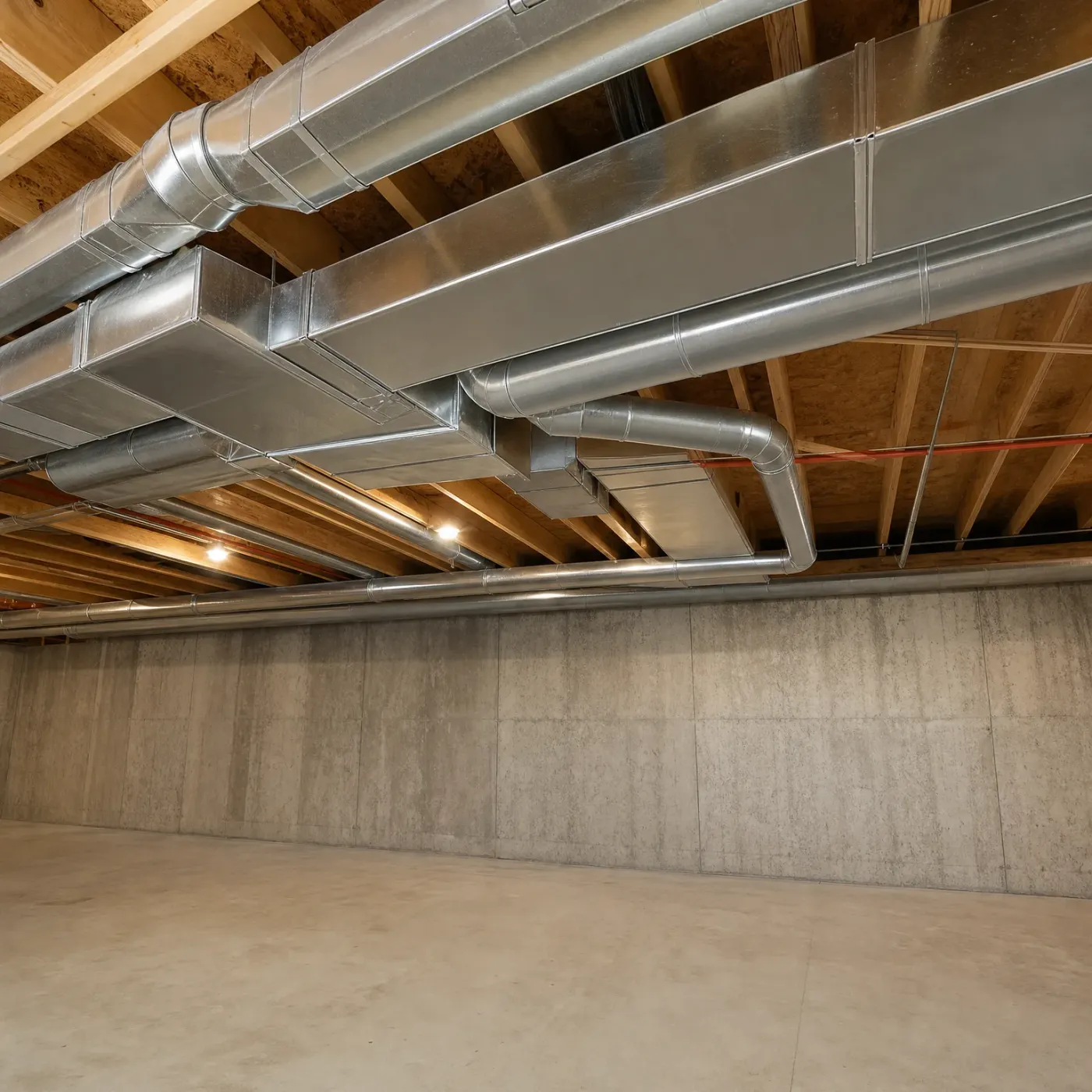
Unfinished basement with bare concrete floor and walls, showing galvanized sheet-metal HVAC ducts, pipes and recessed lights beneath a wood-joist ceiling.
Tight joints and sealed seams keep the air moving where the fan is pushing it, so every room off this trunk gets its fair share.
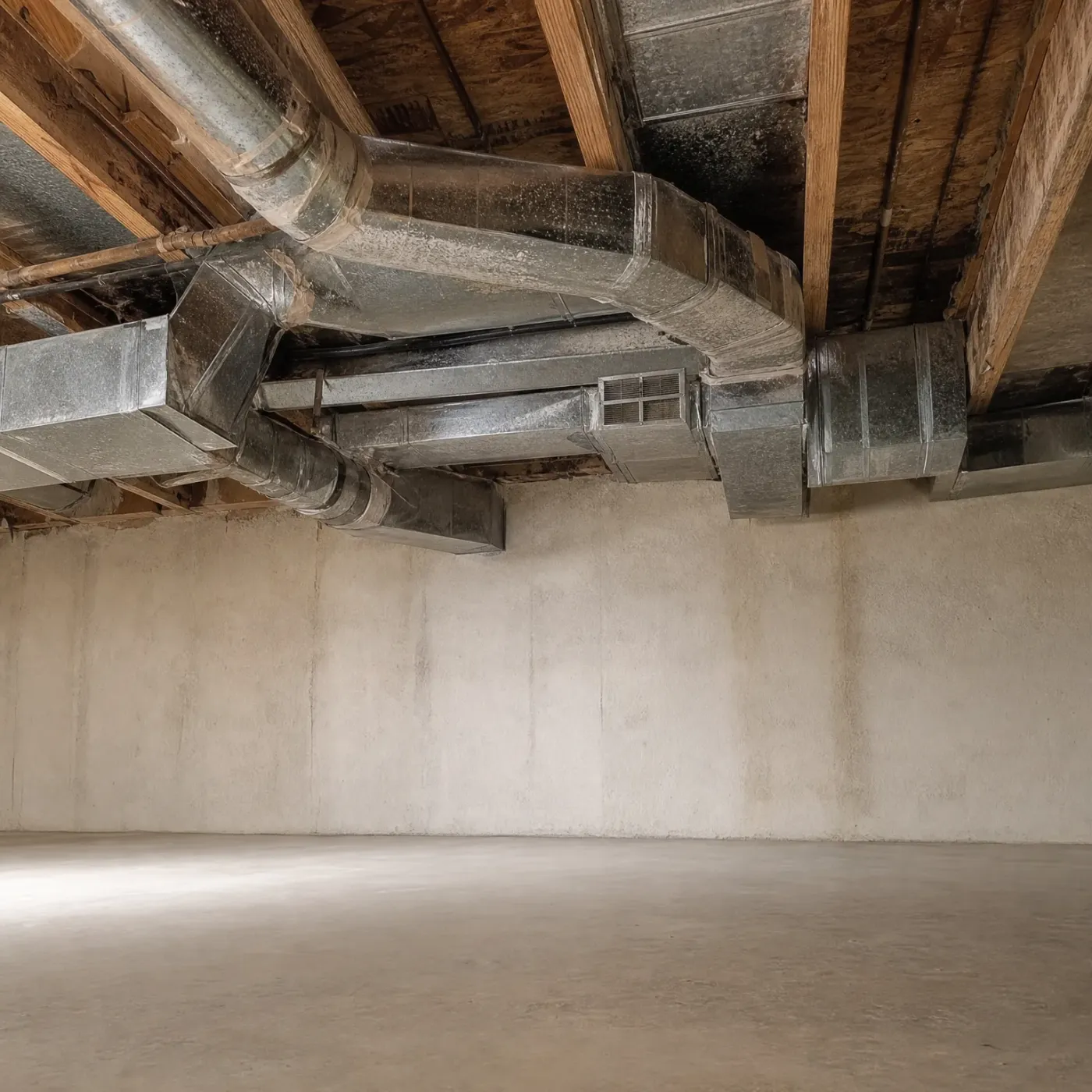
An empty basement room with bare concrete walls and floor, with galvanized sheet-metal HVAC ductwork and a vent grille running along the wooden joist ceiling.
Dust ringing the seams and dark staining on the metal mark where air has been leaking out for years.
Dim room corner with a framed picture on a textured wall above a counter holding a tall ceramic vase and a shallow wooden bowl, with a sheer curtain beside a window and a ceiling air vent overhead.

It is one of those mild spring afternoons when the furnace has finally stopped running and the house just sits quiet. Sun comes through the living room window and catches it: a ring of gray dust around the ceiling vent grille, and a thin film of it settled across the top of the TV stand and the picture frames below. Nobody tracked that in. It rode the air out of the duct all winter and landed the only place it could. You wipe the shelf down, and by the time the furnace kicks on again in the fall, it will be back.

Checking It Yourself vs. Having It Checked

Checking it yourself

  • You can hold a hand near each register and feel whether the air coming out is weak, which points to a leak somewhere between there and the furnace.
  • You can look in the attic or crawlspace for duct sections that feel hot or cold to the touch when the system is running, since that means conditioned air is escaping before it reaches the room.
  • You can check the metal seams and flex duct joints you can reach for dust rings or loose tape, which tells you where air has been leaking out for a while.
  • You can compare how long the furnace or AC runs against what the thermostat shows, and a run time that seems long for the temperature swing is worth noting.
  • You can walk the house room by room and note which ones never match the thermostat setting, since that pattern usually traces back to one weak run of duct.

Having it checked

  • A contractor who works on Baltimore County duct systems every season can pressure test the whole system and find leaks that are not visible from a register or an attic walk-through.
  • A local contractor already knows which duct materials and layouts tend to fail in homes built around here, so the inspection starts with a sense of what to look for.
  • One contractor means one visit and one assessment of the whole system, instead of the back and forth of describing the problem to several companies and sorting through different answers.
  • A proper inspection covers the return side too, which pulls air into the system and is easy to miss when you are only checking supply registers by hand.
  • Sending one request instead of calling around saves you the work of finding a contractor on your own and repeating the same explanation to each one.
A smiling woman with long brown hair in a cream sweater sits at a stone counter with a glass of red wine, with a dimly lit living room, beamed ceiling and glass doors behind her.
A woman with shoulder-length dark wavy hair in a beige sweater laughs while looking off to the side, seated at a white marble counter with a glass of red wine, in a dimly lit home interior with a kitchen and sofa in the background.
A smiling woman with long dark hair in a black sweater sits at a white marble counter with a glass of red wine, in a dimly lit kitchen and living area with pendant lights, a potted plant, and flowers.
A smiling woman with long brown hair in a light knit sweater sits at a stone-topped counter with a glass of white wine, with a dimly lit living room, sofa, fireplace and round mirror behind her.

No calling every shop in Baltimore County

You can feel along the registers and look in the attic yourself, and that tells you something is wrong. It won't tell you which seam, which run, or whether the fix is a few feet of mastic and sealed collars or a flex section that needs replacing. That takes someone up in the attic or crawlspace with a hand on the duct, tracing the run from the furnace out. A contractor who works on this equipment all over the Dundalk area every summer and winter has seen which runs separate first in homes like yours and which leaks are behind the rooms that never feel right. Finding that person usually means a few calls, explaining the same thing each time, and sorting through quotes that aren't quite comparing the same work. Here, the request goes to one local, licensed contractor who already knows what to check first, so the next conversation you have about your ducts is with someone standing in your attic, not another stranger on the phone.

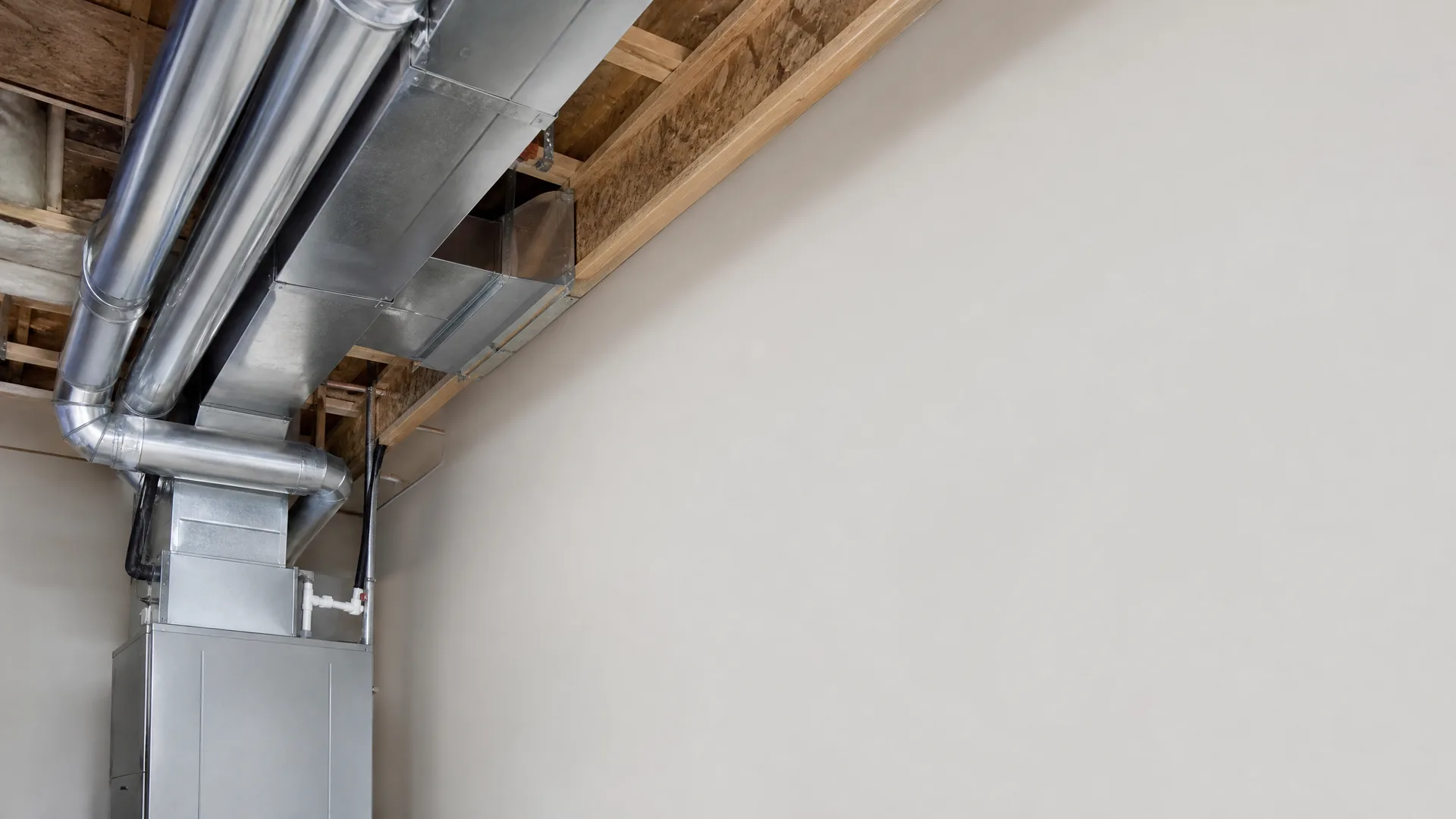
Galvanized sheet-metal ductwork and round pipes running along an exposed wood-joist ceiling with insulation, above a furnace unit beside a blank painted wall.

Why the trunk line matters most

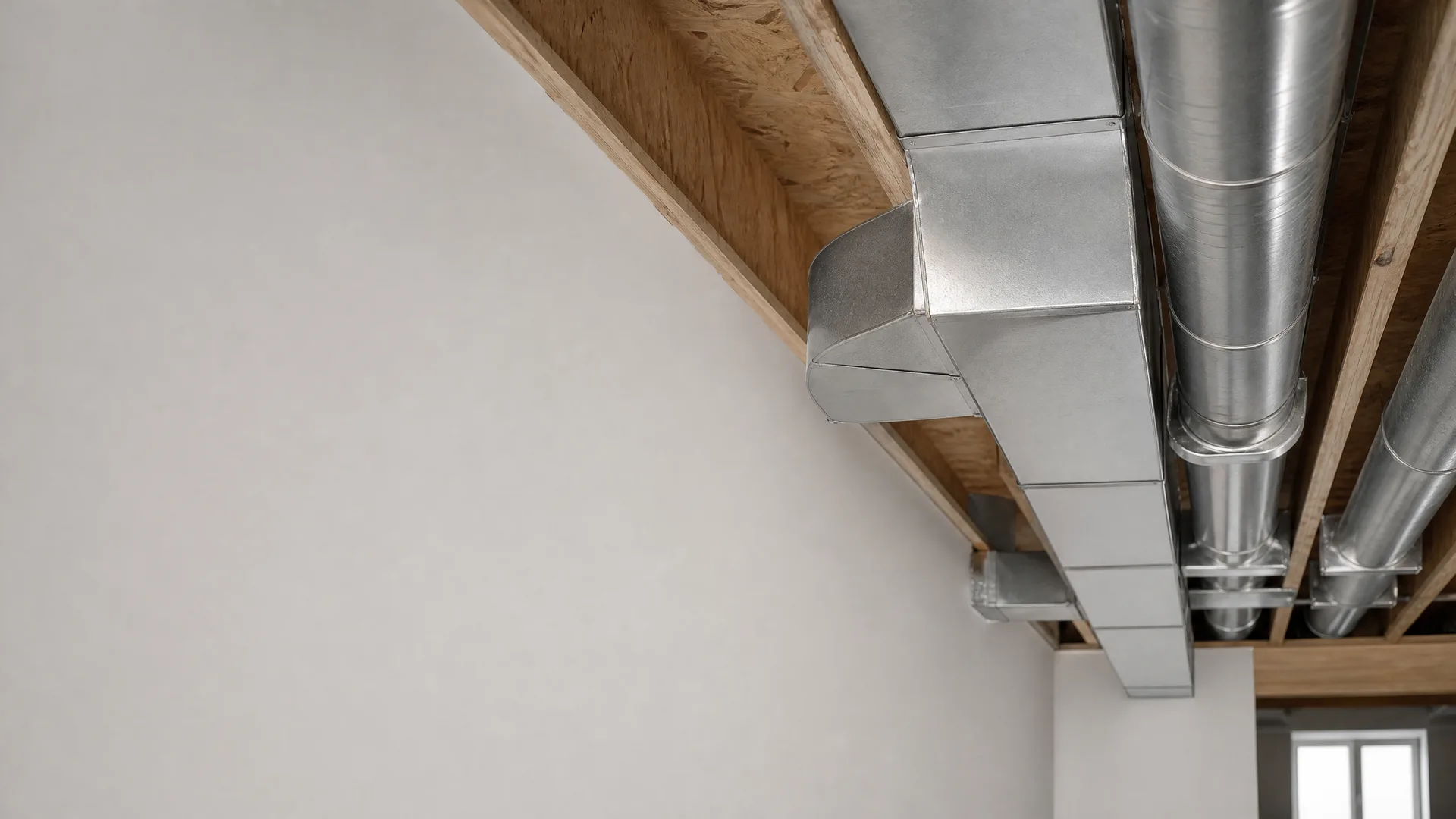
The main trunk carries all the air before it splits off to each room's branch duct. A leak in the trunk, where it leaves the furnace or air handler, costs every room downstream, not just one. That's why a leak near the equipment can shrink output across the whole house, while a leak out at a single branch run only shorts the room or two it feeds.

Galvanized rectangular and round sheet-metal ductwork mounted beneath an exposed wooden joist and OSB ceiling, next to a plain white wall and a window at lower right.

What a blower door won't fix

Sealing the ductwork does nothing for a window that leaks air or insulation that's thinned out over the attic floor. Those are separate problems with separate fixes. But if your rooms are uneven and your ductwork runs through an attic or crawlspace in a Dundalk-area home, the duct seams are the first place a contractor checks, because that's where conditioned air most often gets lost before it reaches you.

Power here costs 20.22 cents per kilowatt-hour

At just over 20 cents a kilowatt-hour, every extra minute your blower runs to make up for leaking ducts shows up on the bill. Air pushed into an attic or crawlspace instead of a bedroom is power you paid for and never felt.

EIA-861 2025

Ductwork you can see

A basement or crawlspace with exposed metal trunk and branch lines gives you a shot at finding the problem yourself. You can run a hand along the seams while the system is on and feel for air escaping, or look for the dust rings and staining that mark a leak that's been there a while. A loose collar or a seam gone soft with age is often right in front of you. What you can't always tell from a look is whether that's the only leak, or just the one you happened to find.


Ductwork buried out of reach

Plenty of homes in the Dundalk area run ducts through finished ceilings, behind walls, or packed under insulation in a crawlspace you can't get into without crawling flat on the ground. There's no seam to touch and no run to follow by eye. The only signs you get are the ones the house gives off: a room that won't hold temperature, a bill that keeps climbing, a vent that barely pushes air. Finding the actual leak means someone testing the system directly, not looking at it from outside.

A smiling middle-aged man in a dark green sweater sits at a candlelit table with a glass of red wine and a bowl of salad in the foreground.
A woman in a cream knit sweater reclines on a beige couch with eyes closed and a slight smile, a gray hardcover book resting open on a textured blanket over her lap, with a lit table lamp and a leafy plant in the dim background.

Sealed ductwork

Air goes where you set the thermostat. Rooms stay even, the blower shuts off on schedule, and nothing is paying to heat or cool your attic or crawlspace.

Answer a few questions

Leaky ductwork

Some of what the furnace or AC makes never reaches a register. The blower runs longer to compensate, and that extra runtime is on your next bill.

Answer a few questions
A closed laptop and a ceramic mug of coffee on a wooden table, with a blurred kitchen counter, cutting board, utensil jar and plant in the background.

What this comes down to

A room that won't hold its temperature, a blower that runs too long, a power bill that keeps climbing in Dundalk's humid summers and cold Baltimore County winters. All three point to the same thing: air leaving the ducts before it reaches the register. Once you know that, the question isn't whether to look into it, it's who checks the trunk line, the branch runs, and the seams in your attic or crawlspace to find where it's happening.

That's the part that takes more than a flashlight and a free afternoon. Finding a contractor who works on ductwork, explaining what you've noticed, waiting on a callback, then doing it again with the next name on the list is its own job. Submit this page's request instead and it goes to one licensed contractor local to the Dundalk area, someone who sees this kind of leak every season and knows where to look first. No comparing quotes, no repeating yourself to three different companies. Just the system checked and, if it's leaking, sealed.

A large weathered ceramic vase and a shallow wooden bowl sit on a rustic wooden table beside a window with linen curtains, with a blurred sofa with cushions and a hanging fabric panel in the background.
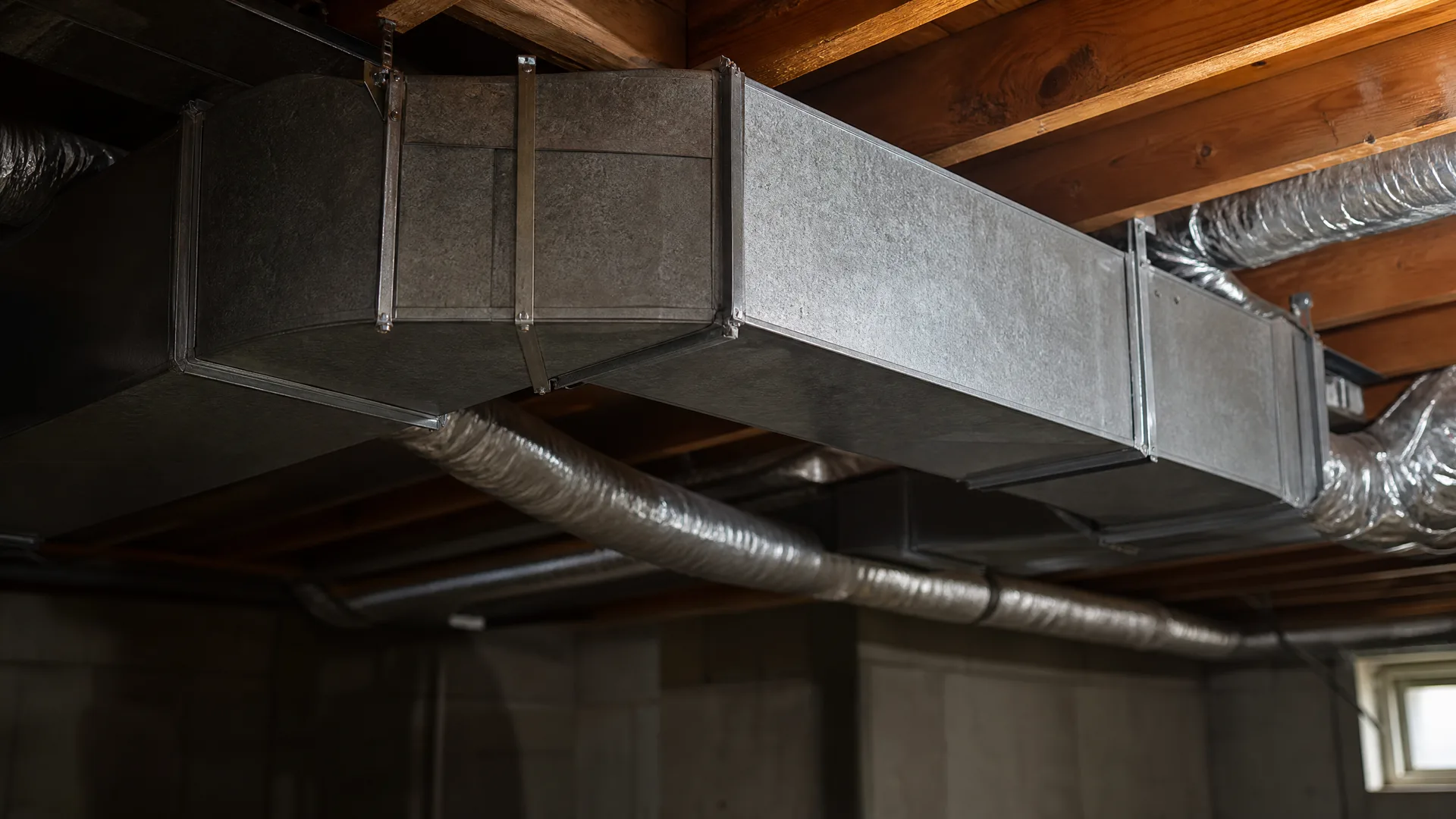
Rectangular sheet-metal HVAC trunk ducting and insulated flexible ducts running along wooden floor joists in an unfinished basement ceiling above concrete block walls.

Skip calling around

Duct and vent cleaningDucts or ventsBaltimore County, MD
Step 1 of 2

What ZIP code is the job in?