Profile view of a bearded man wearing a dark baseball cap and a dark gray T-shirt against a plain off-white background.

Is a clogged dryer vent a fire risk in Maryland

Duct and vent cleaningMaryland
Step 1 of 3

What kind of equipment?

Is a clogged dryer vent a fire risk in Maryland?

You run a load of laundry most nights, and lately it's taking two cycles to get clothes dry, or the top of the machine feels hot to the touch. Someone mentioned the vent could be a fire hazard, and now you're wondering if that's really true or just something people say.

Yes, a clogged dryer vent is a real fire risk

Lint is dry and catches fast, and a clogged vent traps it right next to the heating element with nowhere for the hot air to go. The dryer keeps pushing out heat, the air backs up instead of venting outside, and the lint sitting in that line is what ignites. This is the leading cause of home dryer fires nationwide. In Maryland, summers get humid, and a vent that's already restricted has a harder time clearing that damp air, so the dryer runs hotter and longer to get clothes dry. That extra run time means more heat sitting in a blocked line for more hours of the day.

A white hooded louvered vent mounted on beige horizontal lap siding above a stucco foundation wall bordered by river rock gravel.

Vent clear and venting

Air pushes straight out through the hood with every load. The flap swings open while the dryer runs and falls shut when it stops. A dryer in this shape finishes a load in one cycle, and the lint stays where it belongs, in the trap, not packed into the duct behind the wall.

A white plastic hooded dryer vent with a lint-covered screened opening mounted on beige horizontal vinyl siding above a concrete foundation.

Vent blocked with lint

The screen is caked with dark lint and the flap barely moves. Hot, damp air backs up into the duct instead of leaving the house. That buildup is fuel sitting next to a heat source, and it's why the top of the machine feels hot and why one cycle isn't enough anymore.

Why does my laundry room feel so warm lately

Run your hand over the top of the dryer after a cycle. If it feels hot instead of warm, or the laundry room itself feels warmer than the rest of the house, air isn't getting outside the way it should. Check the outside hood too. With a clear vent, you can feel steady airflow against your hand and see the flap lift while the dryer runs. If there's barely a puff of air, or you catch a burnt-dust smell near the machine, lint is sitting somewhere in that line instead of venting out. That trapped lint is what catches fire, and with the dryer running most nights, it's building up load after load.

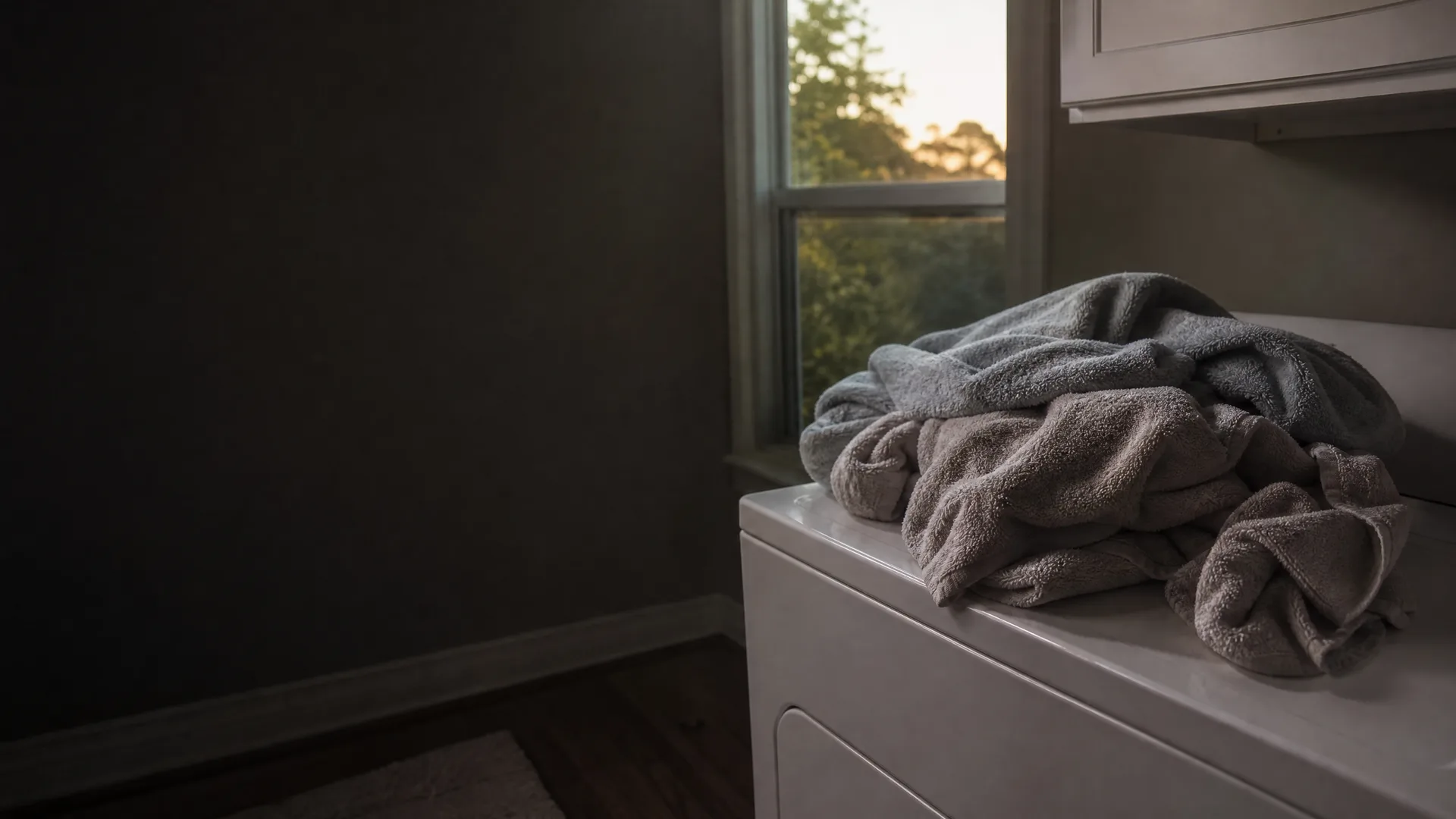
A pile of gray and taupe towels sits on top of a white laundry appliance in a dim room beside a window with trees and sunlight outside.

It's almost nine and you're still in the laundry room. The towels have been through twice already and the top layer is still damp, cool in that way that means they'll sit overnight if you let them. The dryer ticks as it cools. You press a palm to the lid out of habit and pull it back, it's hot, hotter than it should be after just a cycle. The room smells faintly warm, like the inside of a closed car in July. Outside it's sticky, the kind of Maryland evening where the house already feels close, and now this room is worse than the rest of it. You leave the towels where they are and go find the form on your phone instead.


It's off your list after this

A clogged vent doesn't fix itself by running another cycle. Lint keeps building behind the clog, the dryer keeps pushing hot, damp air into a space it can't escape, and the risk climbs a little more with every load. In Maryland, with summers this sticky, the air already carries moisture, so a vent that's restricted has even less room to push air through, and the heat has nowhere to go but back into your laundry room. Electric heat costs enough here already without a dryer working twice as hard to dry one load. None of that gets better on its own. A contractor who clears vents in homes around here knows the clog is usually sitting further down the line than it looks from the hood, and knows what a dryer vent is supposed to feel like after a load when it's actually venting right. Send the request, and let someone who does this work every week figure out where yours stands.

How a clogged vent starts a fire

  • Heat from the drum pushes lint through the duct, and restricted airflow lets that lint settle on the duct walls instead of blowing outside.
  • Lint ignites at a lower temperature than paper, and the dryer's heating element sits right at the point where airflow is weakest.
  • A clogged vent makes the thermal limit switch cycle on and off trying to keep the drum from overheating, which stresses the part with every load.
  • Flexible foil or plastic duct sags in the middle, and lint collects at that low point long before it reaches the vent hood outside.
  • The vent hood flap should swing open fully when the dryer runs; one that barely lifts means the duct is already restricting airflow.
  • Lint that builds up around the heating element or igniter has more direct contact with the heat source than lint further down the duct.

A dryer works by pushing hot air through wet clothes and out through the duct, carrying lint along with it. When the duct is clear, that lint rides the airflow all the way to the vent hood outside. When it's restricted, the lint has nowhere to go, so it drops out of the airstream and settles on the duct walls, usually at a low point in the run or right near the heating element. That matters because lint catches fire at a lower temperature than paper does, and the heating element is the hottest part of the whole system. The further the airflow is cut off, the more heat has nowhere to go either. Normally the thermal limit switch catches that and shuts the heating element off before the drum gets dangerously hot. With a clogged vent, that switch ends up cycling on and off almost every load, turning the element off and on to chase a temperature it can't get ahead of. That's wear the switch isn't built to take over and over. Flexible foil or plastic duct makes this worse if it sags anywhere along its run, because lint settles in the dip instead of making it out through the hood. The hood flap is the easy way to check from outside: with the dryer running, it should swing open wide. If it barely moves, the duct behind it is already holding more lint than it should.

A smiling bearded man in a dark green hooded jacket and blue t-shirt sits on a couch in a living room with shelves, a potted plant, and a bowl of popcorn on a wooden table.
A smiling man in a green long-sleeved shirt sits on a beige sofa in a living room, with a bowl of popcorn in the foreground, a large potted plant and shelving behind him.
A smiling man in a dark blue T-shirt sits on a couch in a dimly lit living room with a bowl of popcorn and a remote on a wooden table, a lit floor lamp and bookshelves behind him, and windows showing greenery.
A smiling bearded man in a dark green long-sleeved shirt sits on a leather couch in a living room, with a bowl of popcorn and a remote control on a wooden table in the foreground.

Most dryers push air out at a temperature well past the point where lint starts to burn. A clogged vent holds that heat inside the duct instead of letting it vent outside with each load.

That's the part a clogged vent changes. The heat that should leave your house stays trapped against a wall of lint, and the dryer keeps producing more of it with every cycle you run.

Power costs 19.53 cents per kilowatt-hour statewide

A clogged vent makes the dryer run longer to finish each load, and at 19.53 cents per kilowatt-hour, those extra cycles show up on the bill fast. Getting the vent cleared isn't just about the fire risk, it's the faster, cheaper way to dry a load too.

EIA-861 2025 statewide residential average

A white hooded dryer vent cover mounted on beige horizontal vinyl siding above a concrete foundation wall with gravel at the base.

The hood sits open and clear

The flap hangs loose and the duct behind it is open all the way through. Air and lint pass straight out with each load, so none of it collects in the hood or the screen behind it.

A square plastic dryer vent hood mounted on light-colored horizontal lap siding above a concrete foundation, with gray lint clogging its screened opening.

The hood is packed with lint

The mesh is nearly covered and the flap can't swing free anymore. Every load pushes more lint against what's already there, and the hot air behind it has nowhere to go but back into the duct.

A clogged dryer vent is a real fire risk, and in a Maryland laundry room running loads most nights of the week, it's one worth taking seriously rather than watching. The signs you've noticed, the extra cycle, the hot lid, the warm room, are the dryer telling you the vent isn't doing its job. Clearing it is routine work for someone who services this equipment every season in homes around here and knows exactly where lint tends to pack in and what a bad hood or a crushed duct looks like. You'll be matched with one licensed Maryland contractor for this, not a handful of companies competing for your callback, so there's no juggling quotes or fielding calls all evening on top of the laundry. You already know the vent needs clearing. What's left is getting someone out to do it.

A beige upholstered armchair with a dark green pillow sits beside a woven basket holding a cream fringed throw, with a potted leafy plant in a second basket near a window.
Sunlit living room corner with a beige upholstered sofa and striped linen cushion, a potted small-leaved tree in a woven basket beside sheer curtains, a framed artwork on the wall, and a jute rug on a wood floor.
A wooden storage bench with a long linen bolster cushion sits against a pale wall beneath hanging jackets, beside a doorway showing a plant and chair in sunlight, with a woven rug on the wood floor.
A dark wood sideboard holding a shallow wooden bowl and a pale ceramic vase with leafy branches, against a beige wall with a framed artwork and a window showing a sunset sky and trees.
A lit ceramic table lamp with a tapered fabric shade sits on a wooden side table beside a small wooden bowl, with a woven basket on the shelf below, next to a gray upholstered sofa and a dark-framed window at dusk.

Stop chasing a dryer vent pro

Your dryer vent cleaning request goes to one local pro.

Let a pro reach out

There's no charge for the request.